
YAG laser capsulotomy is a quick, painless laser treatment that clears a cloudy membrane behind your lens implant, restoring clear vision after cataract surgery. You might need it if your vision was clear after your original surgery but has gradually become misty or blurry again. This is called posterior capsule opacification (PCO), and it isn’t a returning cataract.
What is PCO?
During cataract surgery, your cloudy natural lens is removed, but the thin membrane that held it in place, called the lens capsule, is left behind to support your new artificial lens. Over time, in some patients, a small number of leftover lens cells multiply across the back of this capsule, thickening it and turning it hazy. Light can no longer pass through cleanly, and vision becomes blurred or glary again in a way that can feel exactly like the original cataract.
It isn’t. Your cataract can’t return, because the natural lens that formed it has already been removed. PCO is a separate, well-understood change in the capsule itself, and it’s straightforward to treat.
How common is PCO?
According to the Royal College of Ophthalmologists’ National Ophthalmology Database, roughly one in five eyes develop PCO after cataract surgery, and NHS guidance confirms this can happen months or even years after otherwise successful surgery. It isn’t a sign that anything went wrong with your original operation. It’s a recognised, treatable part of the healing process for a meaningful number of patients.
PCO Symptoms to watch for
- Vision gradually becoming blurred or misty, weeks to years after cataract surgery
- Increased glare or halos around lights, particularly at night
- Colours appearing duller or less vivid
- Reading becoming harder, especially in dim light
This all sounds familiar because the symptoms are similar to cataract symptoms. So PCO is sometimes called a “secondary” cataract. So if any of this sounds familiar and it’s been a while since your original surgery, it’s worth booking an eye examination rather than assuming you simply need a new glasses prescription.
How is PCO diagnosed and treated
An ophthalmologist confirms PCO with a slit lamp examination, a close look at the front of the eye that shows whether the capsule behind your lens implant has thickened. Once confirmed, YAG laser capsulotomy is the standard next step.
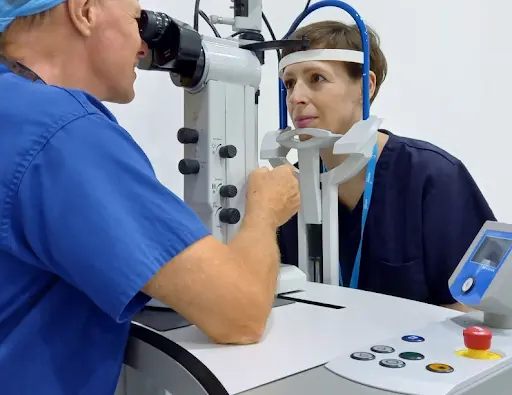
The treatment is a same-day outpatient laser procedure rather than surgery in the traditional sense. There are no incisions and no stitches involved. you’ll first be given eye drops to dilate your pupil, which take around 20 to 30 minutes to work fully. A big contact lens is may be placed on the eye to help the surgeon do the treatment. You’ll rest your forehead and chin against a support at the laser machine, much like a standard eye examination. The laser itself takes only a few minutes, and while you may notice bright flashes of light or hear soft clicking sounds, the procedure is painless. You’re free to leave shortly afterwards, though you’ll need someone to drive you home.
PCO Recovery and what to expect afterwards
Your vision will stay blurred for a few hours immediately after treatment, purely because of the dilating drops rather than the laser itself. Most patients notice a clear improvement within hours, and full clarity is typically restored within a day.
You shouldn’t drive or cycle until the effects of the dilating drops have fully worn off, and floaters are common for up to two weeks afterwards, as more light is now reaching the back of your eye. This settles on its own. Steroid eye drops are sometimes prescribed for a short period to reduce mild inflammation, though not every patient needs them, and routine follow-up isn’t usually required. It’s sensible to have your optometrist check your vision around a month later, once any temporary blurring or floaters have fully settled.
Risks and possible complications of YAG laser capsulotomy
YAG laser capsulotomy is a well-established, low-risk procedure, and complications are uncommon.
The common, usually temporary effects include floaters that settle within a few days to weeks, a brief rise in eye pressure that’s usually managed easily with eye drops, and mild inflammation inside the eye. Less commonly, the laser can leave small marks on the surface of the lens implant, which can occasionally cause glare but rarely affects vision otherwise. Very rarely, patients can experience retinal detachment, macular oedema (swelling of the central retina), or dislocation of the lens implant.
Your consultant will talk you through your individual risk before treatment, and if you notice worsening redness, pain or vision loss afterwards, this needs an urgent same-day check rather than waiting for a routine appointment.
Ready to get your vision checked?
If your vision has become misty or blurry since your cataract surgery, it’s worth getting it checked rather than living with it. Mark Wevill and his team can assess whether YAG laser capsulotomy is right for you. Visit Laser Eye Surgery Birmingham to find out more or book a consultation.
Frequently asked questions
Will I need new glasses after YAG laser capsulotomy?
Usually not. YAG laser capsulotomy clears the capsule behind your lens implant, but it doesn’t change the underlying focusing power of your eye, so your glasses prescription typically stays the same. Occasionally, once the haze has cleared, a small amount of astigmatism becomes more noticeable than before, in which case your optometrist may suggest a minor update to your prescription once your eye has settled, usually a few weeks after treatment.
Is YAG laser capsulotomy a one-off, permanent fix?
Yes. Once the laser has opened the cloudy section of the capsule, that opening is permanent, and PCO won’t return in the same eye. If you develop symptoms in your other eye at a later date, that’s treated as a separate, unrelated occurrence of PCO.
Is YAG laser capsulotomy covered by the NHS or insurance?
YAG laser capsulotomy is available on the NHS when clinically appropriate, though waiting times vary by area. For private patients, it’s generally treated the same way as the original cataract operation for insurance purposes. See our guide on whether private medical insurance covers cataract surgery for more detail on how that works.
Is YAG laser capsulotomy painful?
No. A numbing drop is used, and most patients describe the procedure as painless. You may notice clicking sounds or flashes of light, but nothing more.
How soon after cataract surgery can PCO develop?
It can happen anywhere from a few months to several years after your original surgery. There’s no fixed timeline, which is why it’s worth getting any gradual change in vision checked rather than assuming it’s unrelated.
What’s the alternative to YAG laser treatment?
There isn’t a non-laser alternative once PCO is affecting your vision meaningfully. Stronger glasses can help in the very short term, but they don’t address the underlying capsule clouding. If your PCO is mild and not yet affecting daily life, your consultant may simply recommend monitoring for now.
Can PCO happen after lens replacement surgery too, not just cataract surgery?
Yes. The same capsule is used to support the lens implant in both cataract surgery and lens replacement surgery, so PCO can develop after either procedure, for the same reasons.