

Globally, about 43 million are blind with cataracts and the vast majority are in low- and middle-income countries especially in sub-Saharan Africa (SSA). On average, there are about 2.5 ophthalmologists per million population in SSA) with many low-income countries below one per million. By comparison, there are a about 76 per million in high-income countries.
Professor Filomena Ribeiro, the 2024 president of the European Society of Cataract and Refractive Surgeons (ESCRS) says that the shift toward building local surgical capacity is a cornerstone of ESCRS’ charitable strategy to help reduce avoidable blindness. Therefore, The ESCRS is supporting a few eye surgery delivery and training projects in SSA.
In June 2024. Mark Wevill, who is on the ESCRS charity committee visited projects that the ESCRS supports in Cape Town, Malawi and Mozambique with Mr Tom Ogilvie Graham, the ESCRS managing director.
In South Africa, the University of Cape Town founded the Community Eye Health Institute (CEHI) which trains postgraduate professionals in management and clinical skills to deliver more effective eye care. The institute has benefitted millions of people mainly in Africa, but also the Middle East, and Asia.
The ESCRS is one of the funders of the Institute and in June 2024 Mark Wevill travelled to Cape Town as one of the surgical trainers again and to assess the impact of the ESCRS funding on the surgeon training. “Collaborating with successful and experienced regional partners such as the CEHI maximises the impact of the Society’s funding to reduce avoidable blindness in sub-Saharan Africa.” He says. “The benefit of ESCRS funding of the CEHI surgical training unit is exponentially multiplied by training sub- Saharan African surgeons at the institute. Because not only are greater volumes of cataract surgery done better and more safely by each surgeon, improving the quality of life of blind people all over sub-Saharan Africa, but education builds a legacy. These graduates pass on the skills learned to other surgeons and the graduates can return to the institute as trainers sustaining the great work of the institute”. In addition, other ESCRS members are giving their time and expertise to reduce avoidable blindness by becoming CEHI trainers.
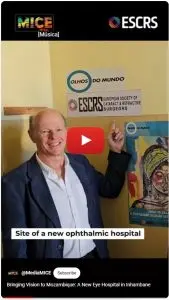
Eyes of the World (Olhos Del Mundo) is a good example of a collaborative capacity-building programme. It has been operating in Africa and South America for 22 years. To date, it has trained more than 13,000 local professionals, including ophthalmologists, optometrist, eye technicians, traditional practitioners, and teachers in detecting, referring, and treating vision problems. ESCRS and its members have supported the organisation in Mozambique for a couple of years. The project’s goal is to deliver 3,300 cataract surgeries, of which at least 50 percent will be women because women usually receive less health care in most of SSA than men. So equitable delivery of eye care is a priority of Eyes of the World.
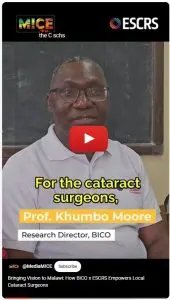
The ESCRS team then travelled to Malawi to visit the ESCRS-supported programme partnering with the Blantyre Institute for Community Outreach (BICO). The ESCRS grant supports surgeon training, and cataract surgery delivery in Malawi to enable surgeons to improve the quantity and quality of the cataract surgery they perform.
The quantity and quality of eye surgery in Africa is improving, but there is still a long way yet to go. Training and programme support are keys to ending avoidable sight loss. Despite two decades of progress reducing avoidable blindness before 2020, the need remains vast.