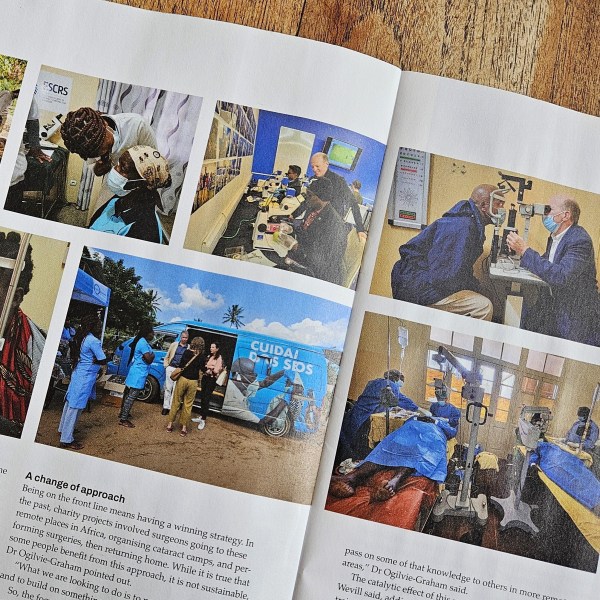
The ESCRS is going beyond cataract camps.
Last June, three people from the ESCRS (European Society of Cataract and Refractive Surgeons) sat under a tree in a village in a remote region of Mozambique, in south-eastern Africa. They spoke with community leaders about the importance of eye care and how it should be accessible to everyone. Those three people were Filomena Ribeiro (ESCRS president), Mark Wevill (ESCRS charity committee), and Tom Ogilvie-Graham (managing director), visiting one of the charity projects supported by the ESCRS in Sub-Saharan Africa, following the mission of providing eye care for everyone globally.
According to the World Health Organization (WHO), eye healthcare is a vital issue in Africa. Around 26.3 million people are visually impaired, and among these, 20.4 million have low vision and 5.9 million are estimated to be blind. WHO reports that Africa has 15.3% of the world’s blind population. While most vision issues affecting the African population are treatable, the average number of ophthalmologists per million people is 2.5, compared to 76 per million in Europe.
Currently, the ESCRS has two major projects in Africa: one in Mozambique with Eyes of the World, a Spanish organisation that has worked there for many years, and the second in Malawi with the Blantyre Institute for Community Outreach (BICO). A smaller project in South Sudan supports Dr Lado, a Sudanese ophthalmologist.
“A principle we have is we want to support organisations that already have a good record providing services because they are experts,” said cataract and refractive surgeon and surgical trainer Mark Wevill. In the past, charity projects involved surgeons going to these remote places in Africa, organising cataract camps, and performing surgeries, then returning home. While it is true that some people benefit from this approach, it is not sustainable, Dr Ogilvie-Graham pointed out. So, the focus is on training ophthalmologists and the ancillary staff—the nurses, technicians, and optometrists.
“The emphasis has shifted a lot now—it is on upskilling and training African surgeons to do more surgeries and to do them better,” Dr Wevill said. Moreover, African countries often have stricter regulations regarding permission to perform surgeries, while training does not involve any bureaucratic issues.
The focus on training is particularly important in another ESCRS project with the Community Eye Health Institute at Cape Town University in South Africa. “It concentrates on training the trainers and bringing people from all Sub-Saharan Africa to Cape Town, where they have an intensive three-day [workshop] in dry labs using artificial eyes and even simulators to improve their skills and pass on some of that knowledge to others in more remote areas,” Dr Ogilvie-Graham said. The catalytic effect of this project can really be effective, Dr Wevill said, adding ESCRS members can take an active part in training their African colleagues, maximising the benefits and the impact.
Finally, raising awareness of eye care is extremely important. Many people in remote areas do not know they can get their visual impairment, such as cataracts or uncorrected refractive errors, cured. In his experience, Dr Wevill noted many refer to the local herbalist for a cure or accept blindness as a natural part of life, which in most cases it is not.